
My July post called three June announcements “trigger points,” and more has happened since. A trigger point is a meaningful signal that tokenized money, encompassing both stablecoins and tokenized deposits, has entered a new phase. September brought us another round of meaningful announcements, and the picture has become even clearer. Tokenized money is increasingly looking less like a parallel financial system and more like new infrastructure being built into existing ones by familiar banks, networks, and technology providers. For credit unions, the near-term question is shifting from whether to launch a stablecoin to how they will access this infrastructure and on what terms.
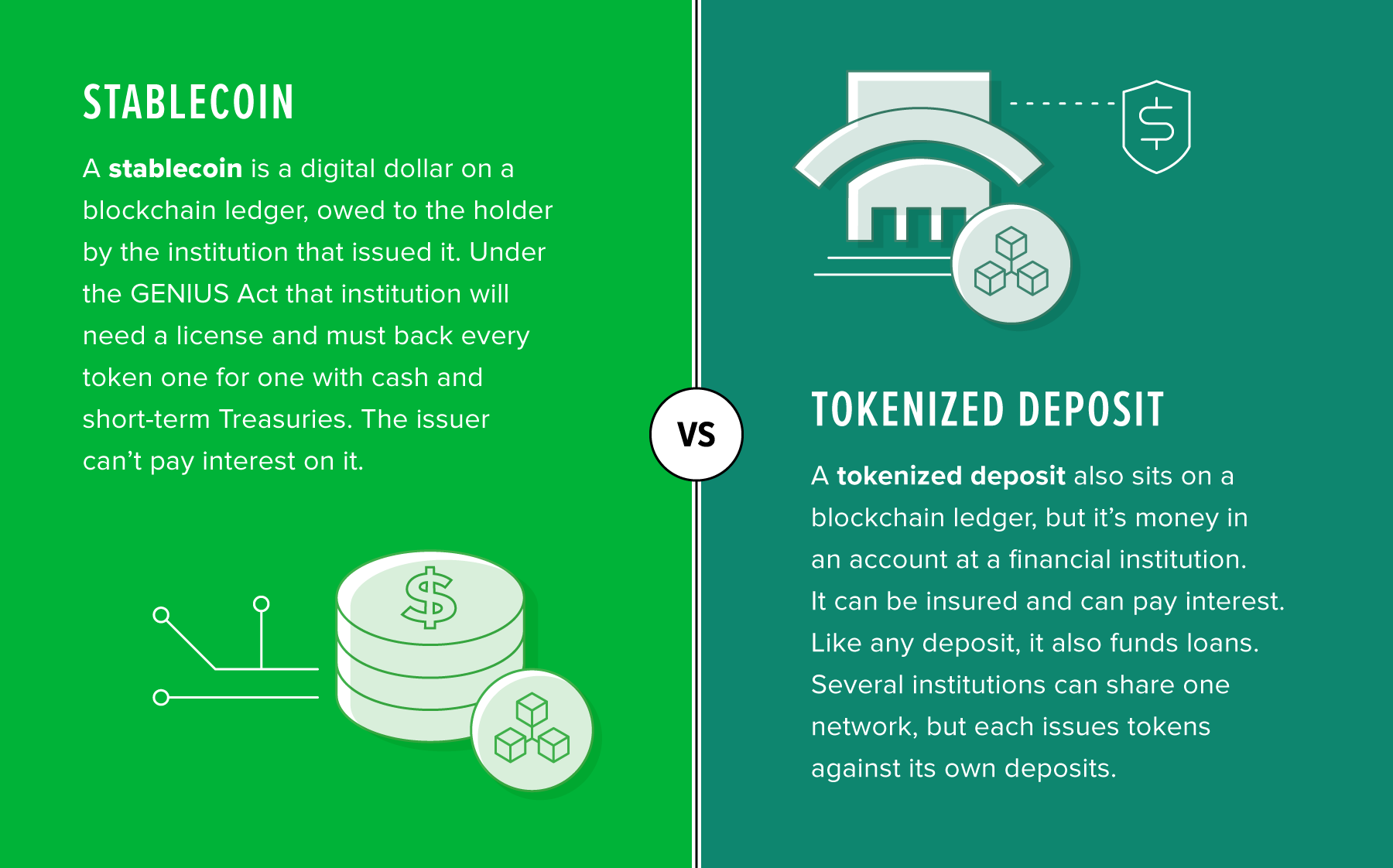
First, an update on initiatives that I wrote about in the last blog.
- The Clearing House tokenized deposit network. Led by JPMorgan Chase, Bank of America, Citi, and Wells Fargo. Launch still planned for the first half of 2027. No credit union has been named, and The Clearing House says institutions of all sizes will have a way in without saying on what terms.
- Open USD. Founded by Visa, Mastercard, Coinbase, Stripe and Shopify, which put up more than $1 billion to get it started. Live since Sept 30. Businesses can swap dollars for Open USD and back at no charge through founders’ platforms. No credit union was named at launch.
- ZelleUSD. Issued by Early Warning, the company that runs Zelle. Minting reportedly started in July, with no launch date set. First use is still intended for United States–India transfers, planned before the end of 2026. No word yet on how credit unions that offer Zelle would use it.
- Amazon and Walmart. Neither has launched or confirmed a coin of its own since the Wall Street Journal reported their interest in June 2025. Retailers look more likely to use the rails others are building than to issue their own.
What matters for credit unions is that large financial institutions and existing payments networks are now building their own tokenized-money infrastructure alongside existing ones.
Next, three major developments announced in September. For each I say whether it is a plan, an announcement, or a working service.
- Twenty-one large financial institutions, among them Bank of America, Citi, Wells Fargo, Goldman Sachs, TD, and Deutsche Bank, said they will form a company to issue a U.S. dollar stablecoin in the first half of 2027, with a euro coin to follow. A plan. No leaders named, no ledger chosen, and no credit union in the group.
- Coinbase signed Moov and Stablecore to put its stablecoin payments and custody tools in front of as many as 4,000 community banks and credit unions. Announced, not live. Those are reach numbers, not sign-ups, the two groups overlap, and neither released names a live credit union, a go-live date or a price.
- The Senate did not move the CLARITY Act forward. Lacking clarity (pun intended) on market rules for digital assets that this legislation was meant to provide, Coinbase promptly raised the “reward” on USDC balances to 3.75%.
Most of this news is about financial infrastructure that members will never see. The new technology is going in behind the payment networks credit unions already use, and the vendors they already work with will build it. Because the CLARITY Act failed, crypto exchanges like Coinbase can keep paying rewards to people who hold stablecoins, which could pull some deposits away from credit unions. This risk is not unlike threats credit unions already understand.
The rest of this post covers why I now believe tokenized money is becoming part of the plumbing, how large the deposit flight risk is, and what all credit unions should consider now.
Why is it plumbing?
So far, tokenized money is looking more like new plumbing, not a new house. It upgrades the pipes that move money and leaves the system around them in place. Most of this works behind the scenes, between banks, businesses and countries. And each initiative looks a lot like a network that already exists.
The Clearing House network looks like ACH and wires, a bank-owned utility that moves money between banks. Open USD looks like the card networks, with Visa and Mastercard among its owners and businesses as its users. ZelleUSD looks like Zelle with a passport, starting with transfers to India. The 21-institution coin looks like SWIFT and correspondent banking, built to move money between countries. In each case, the firms that own today’s rail are building the next one. Even stablecoin pioneers are drawn in. Circle’s USDC holds about 24% of a roughly $300 billion stablecoin market, yet Coinbase, its largest distributor, is a founder of Open USD alongside Visa and Mastercard.
Credit unions are likely to reach tokenized money through the providers they already work with. Fiserv has launched a digital asset platform, and Jack Henry plans to connect to Google Cloud’s ledger for tokenized deposits. Stablecore plugs into Jack Henry and Q2, and Moov is pitching stablecoin acceptance to the business customers of community institutions, changing the near-term strategic question for credit unions. Most do not need to decide today whether to issue their own token. Instead, they need to understand what their existing providers are building, how they will gain access, what it will cost, and who will control the data and member relationship.
A year ago, credit unions were curious and anxious about stablecoins. That anxiety has somewhat dissipated. In my October conversations with payment executives, stablecoins came up once in 90 minutes among credit union managers, and system partners described them as faster back-end settlement. In a Filene survey of 115 credit unions, only 14% were planning or piloting stablecoin projects, though about half expected stablecoin rules to affect their payments strategy. The industry is starting to treat stablecoins as plumbing.
What still worries credit unions is deposit flight.
How big is the deposit flight risk?
Small today, and possibly larger once tokenized assets mature. The GENIUS Act bars stablecoin issuers from paying interest, but it doesn’t stop an exchange from paying holders a reward out of its own revenue. The CLARITY Act would have let Treasury limit such rewards, but it failed, and Coinbase raised its reward on USDC balances to 3.75%.
That beats most credit union savings accounts. But a member chasing the best rate already has better options. Top online savings accounts pay about 4.0 to 4.3%, and Chime pays 4% with qualifying direct deposit, all on insured balances. Fintechs, neobanks, and even Apple and Starbucks already compete for member balances with better rates, a better app, or both. Stablecoin rewards add one more name to that familiar fight.
The future threat could become what the stablecoin pairs with. If and when tokenized assets mature, exchange consumers may be able to move stablecoins in and out of tokenized money market funds, tokenized stocks, and other digital assets without leaving the exchange, while collecting a reward whenever the stablecoin sits idle. This will depend heavily on future regulation, consumer adoption of tokenized money, and how credit unions’ own technology and products respond to the competition.
Today, stablecoin rewards are better understood as another competitor for member balances, not yet a fundamentally different deposit-flight threat.
What should credit unions do?
First, ask your providers and evaluate your exposure. In July I suggested asking your core and payments providers about tokenized money. Ask again, since they may now have more specific answers. Symitar and Q2 clients can ask about Stablecore, and Fiserv clients about its new digital asset platform. Then use your ACH and card data to find members who already send money to an exchange or payments app. Their deposits are the ones most at risk.
Second, close the expertise gap together. Wallets for tokenized deposits, stablecoins, and tokenized assets are one capability credit unions should understand and test. Some already work together. Velera’s Digital Asset Lab has nine credit unions and five providers, and Stablecore, Circuit, and Curql run an early access program. The next step is getting the lessons learned out to the broader credit union community.
Third, connect credit union efforts to the larger networks. Credit unions already have several stablecoins of their own. St. Cloud Financial Credit Union launched the Cloud Dollar in late 2025. Alloya’s CUUSD is being tested with a small group of institutions. TruStage signed up credit unions for a TSDA pilot in 2026, though its status is unclear. As stand-alone coins, they risk dividing credit unions. As collective know-how, they represent leverage. My July post asked how credit unions would join the big bank networks, and that is still unclear. The Clearing House says institutions of all sizes will get a way in but hasn’t said how or at what cost. Meanwhile, the large networks are setting access, pricing, and participation terms now. Credit unions that have built and run their own coins will know what to ask for and what to push back on.
The trigger point is that the infrastructure is being built now by institutions and providers often outside the system, not that every credit union needs a stablecoin. There is time to prepare, provided it is spent wisely. Know where you stand. Close the expertise gap together. Connect to the networks as one system. Acting together is how credit unions built shared branching and the corporate network, and it is how they can shape tokenized money.
Epilogue. What does the Binance hack change?
In late October, attackers drained the crypto wallets of Binance, the world’s largest crypto exchange. At $6.3 billion, it was the largest theft in crypto history.
Three things set this hack apart. The first is its size: about four times the previous record. The second is the target: Binance, the exchange most of the world trades on. The third is the plunder: about half of what was taken was stablecoins, which I argued are becoming part of the financial plumbing. When I first heard the news, I thought, “You don’t expect brand new pipes to burst.”
On reflection, this is an extension, at a much larger scale, of the fight credit unions already wage against hackers and fraudsters. New technologies like instant payment rails, tokenized money on blockchains, and AI offer compelling benefits, and credit unions have to capture as much of them as they can while containing the downsides.
None of the stolen Bitcoin and Ether could be frozen, but about three quarters of the stolen stablecoins were, and Circle froze nearly all of the U.S. regulated USDC. Had Binance operated under U.S. rules, which it does not, the damage would likely have been smaller. Open USD, ZelleUSD, and the 21-institution coin are being built by regulated firms with more mature security practices, often on more controlled ledgers. I expect both the odds and the cost of an attack like this to be lower there. For The Clearing House’s tokenized deposit network, which has even more controls in place, I expect them to be lower still.
All of this reinforces a message for credit unions: If tokenized money is becoming part of the plumbing, it helps that licensed plumbers—the incumbent banks and payment networks—are the ones building it.


