
This is the first in a blog series following the Center for Member Well-Being’s working group on measuring member financial well-being (FWB).
Led by Filene Fellow Dr. Mat Despard, the FWB Measurement Working Group brings together 27 participants from 12 credit unions to explore one of the industry’s most persistent challenges: how to understand members’ FWB, measure the impact of their efforts, understand whether they are moving the needle, and demonstrate the return on investment of their FWB initiatives. Across six sessions, the group is examining current practices, data sources, measurement approaches, and the capabilities needed to turn FWB data into meaningful action.
This blog series follows the working group’s progress, sharing emerging insights, challenges, and ideas as the group works toward practical best practices for FWB measurement and evaluation. Want to learn more about the working group and follow its progress? Visit the working group landing page.
A view into the working group kickoff
In the first session, participating credit unions spent 90 minutes putting their cards on the table:
- Why they want to measure
- What they are measuring
- How they are measuring it
- What tools they’re using
- And what is getting in the way
Why measure in the first place?
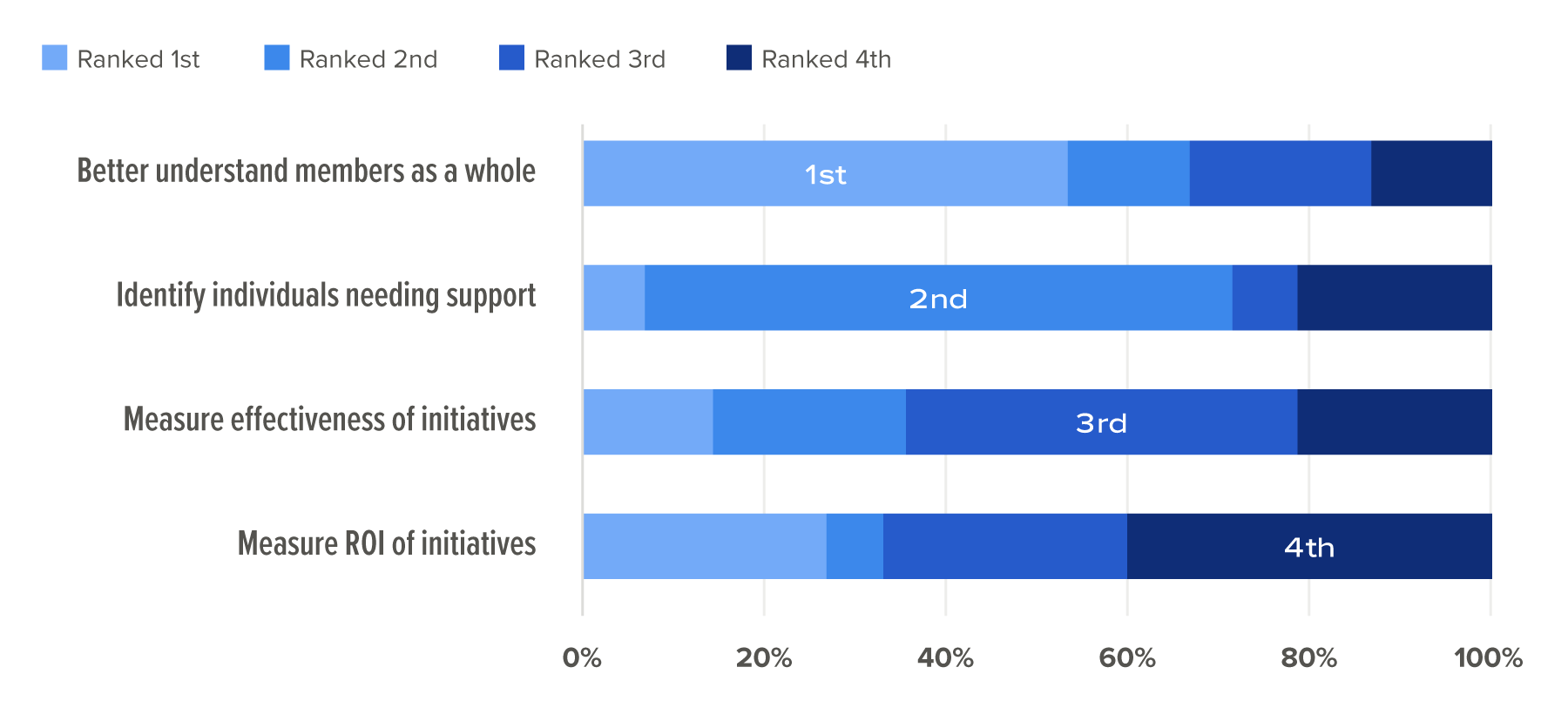
We started off the session grounding our focus in why credit unions were measuring to understand the problem we were trying to solve. Credit unions may measure FWB for different reasons: to understand the current state of their membership, identify members who need support, guide product or program decisions, demonstrate impact, or strengthen advocacy efforts. All of these are important, but they’re not all solved by the same measurement practices.
| Priority Area | Potential Measurement Needs |
|---|---|
| Understanding the membership as a whole | Common FWB measures and benchmarks |
| Identifying members who need support | Better triggers, segmentation, and data infrastructure |
| Proving impact of programs or ROI of FWB investments | Practical program evaluation designs |
In response to a poll asking participants to prioritize why they want to measure FWB, the clear winner was understanding FWB across the membership as a whole, selected by 53% of participants as their top priority, and the discussion that followed reinforced the ranking: Before credit unions can determine whether products, coaching, education, or other interventions improve member well-being, they need a reliable way to define, measure, and understand the current FWB of their members.
What measurement initiatives are credit unions working on?
We then asked each participating credit union to share how their credit union currently measures or has attempted to measure FWB, the tools, measures, or indicators in use, the fintechs, vendors, or platforms involved, the challenges they’ve encountered, and any successes or promising approaches. The main areas of focus were:
- Building FWB scores
- Identifying and integrating data sources
- Finding the right FWB tools and vendors
- Creating FWB segmentation models
Below we describe what credit unions are working on within each of those areas and some of the challenges they’re coming up against.
Building FWB scores—and then figuring out what to do with them
Most participating credit unions are focused on establishing the measurement baseline that surfaced as a top priority. Some are using established scores such as the FinHealth Score or Savvy Wellness Score, while others have opted for creating their own proprietary scores to have more self-reported data integrated into their transaction data. The group sees huge value in FWB scores, but there was no consensus that any existing approach is sufficient. Recurring concerns included:
- The number of competing scoring models
- Heavy reliance on self-reported data
- Difficulty linking scores to outcomes
- The absence of a shared framework across institutions
Although survey-based scores can provide valuable insight into how members perceive their financial lives, there is no shared standard for combining those responses with objective measures such as transactional activity, credit data, and behavioral indicators.
The challenges also don’t stop once the “right” score is developed—credit unions also need to know what decisions, outreach, or interventions should follow. This showed us that many participants see member-level understanding as a prerequisite for tackling more complex questions about whether and why an intervention produced change.
Identifying and integrating data sources
Most credit unions described using three broad categories of information to varying degrees to assess FWB and the outcomes of their FWB efforts:
- Engagement data, such as website traffic, digital banking activity, event participation, and financial coaching participation
- Objective financial indicators, such as credit scores, deposit growth, savings balances, and delinquency trends
- Self-reported or subjective data, such as how members feel about their financial confidence, stress, and peace of mind
The first two categories are relatively rich for many credit unions, but the third is much sparser and is usually collected through short surveys based on score instruments or similar tools. That imbalance matters because objective indicators can show what is happening in an account, but they do not necessarily explain how financially secure or confident a member feels.
The biggest challenge is that the data that credit unions already hold on their members lives in different, disconnected places. Coaches capture information in one system, digital banking engagement lives in another, survey data sits in a third, and getting insights back out of a vendor system into a usable form for the analytics team is, as one participant put it, a constant “burden” that competing priorities keep pushing down the list. Add to that the reality that members’ financial lives are fragmented across institutions the credit union has no visibility into, and even a well-integrated internal dataset is still an incomplete picture.
Personal Financial Management (PFM) and account-aggregation tools, the kind that give members a unified view of their money, came up as one answer to that fragmentation. But several credit unions that have tried this approach candidly noted that adoption is stubbornly low, and members are often reluctant to share aggregated account data even when the tool is available.
Survey fatigue also came up repeatedly: low initial sample sizes and even lower rates of people willing to retake a survey to show change over time, which makes it nearly impossible to track progress rather than just take a snapshot.
Finding the right FWB tools and partners
Credit unions are navigating a landscape with vast service offerings and features. We heard about tools to assess member FWB, support financial education efforts, capture subjective data through surveys, and analyze the data. While some partners and tools serve different purposes, credit unions often use a combination because each tool addresses a different part of the FWB puzzle. Here is a summary of the FWB-specific tools and partners by categories:
| Categories | Purpose | Tools and Partners |
|---|---|---|
| FWB measurement and scoring (some also serve as credit monitoring tools) | Tools/frameworks used to assess or quantify FWB | Financial Health Network / Attune; Ovation; SavvyMoney; Money Habitudes |
| FWB and member experience surveys | Tools mainly used to collect survey responses, feedback, or member experience input | Gallup-Callahan; Medallia; MemberXP |
| Financial counseling, coaching, and debt support | Partners focused on counseling, coaching, debt management, or hardship support | GreenPath; Navicore Solutions; Balance; America’s Credit Unions (FiCEP) |
| Budgeting, PFM, and money management tools | Tools that help people manage spending, budgeting, accounts, or financial habits | MX; Monarch; YNAB; Yodlee; Greenlight; Alkami |
| Analytics, reporting, and internal data infrastructure | Tools used internally to analyze behavior, track metrics, or explore member data | Lumin analytics; SavvyMoney / Savvy; Yodlee; Ovation |
Given the array of options, selection and evaluation of these solutions becomes a project itself. Credit unions must determine what each tool actually does, where its capabilities overlap with technology they already use, whether the data can be integrated into internal systems, and whether members even know the tool is available.
Beyond selecting partners, the challenge is integrating them: credit unions feed each tool system data for implementation, but survey and reporting capabilities often stay isolated, results and insights don’t always make it back into enterprise analytics workflows, and every new tool adopted creates another silo.
Many also described a shift in their approach, becoming less focused on “Which tool should we buy?” and more focused on whether they can get the data back from the tool, whether it integrates into their data warehouse or lakehouse, whether members actually use it, whether its outputs connect to measurable outcomes, whether functionality is being duplicated across solutions, and whether the ongoing cost is justifiable. In fact, the strongest consensus wasn’t around a specific partner or tool at all, it was around the operational challenge of managing multiple solutions and turning their data into something actionable across the organization.
Creating FWB segmentation models
A small number of participating credit unions have developed member segments tied to FWB stages or psychographic characteristics. For most of the group, however, FWB segmentation is talked about as something they aspire to rather than something they are working on now.
Among those that have begun this work, one described how their credit union is using Gallup’s FWB stages to segment members into three FWB groups—Thriving, Struggling, or Suffering. Through this segmentation, they can monitor trends across membership and evaluate whether members’ perceptions and well-being improve over time.
Another described using a psychographic segmentation model built from a large member survey that combined generational characteristics with measures of financial literacy, budgeting behaviors, and understanding of net worth. The model grouped members into six distinct segments and was later condensed into a six-question typing tool to make segmentation more scalable. In addition to financial behaviors, the segmentation incorporated factors such as technology savviness, financial goals, and satisfaction with one’s financial situation.
These approaches have generated rich insights about different member profiles and needs, but translating them into individualized interventions and tracking outcomes at the individual-member level has proved challenging and resource intensive. Participants also noted additional challenges like survey participation bias and the difficulty turning segmentation findings into operational decisions across the organization.
What’s next
We closed the session by asking the group to rank the challenges that matter most for us to tackle together. The results reflected the topics that had dominated the session:
- Aligning on a shared definition of what to measure was the clearest priority
- Connecting data to outcomes
- Uniting fragmented data across systems and partners
So, while the second session will still dive into surveys, we’re planning to spend more of our remaining sessions on transaction and behavioral data, given how much of this conversation kept circling back to data connection and infrastructure.
This direction lines up with a potential combined approach where survey data reinforces member account and product data to create a model that can accurately assess members’ subjective and objective FWB on an ongoing basis. Most importantly, it would mean a model that, over time, relies less and less on needing time-intensive and difficult-to-get direct member input.
A couple of our participating credit unions are already headed down that path, and bringing that kind of thinking—and our own exploration of what advances in AI can add to this data—into later sessions is very much part of the plan.


