
Every credit union wants to serve their members in the best way possible. However, what “best service” looks like varies, not only credit union to credit union but even member to member. Members want different products based on where they are in life, their age, or as we have found in recent Member Pulse research, their underlying attitudes and beliefs when it comes to finances.
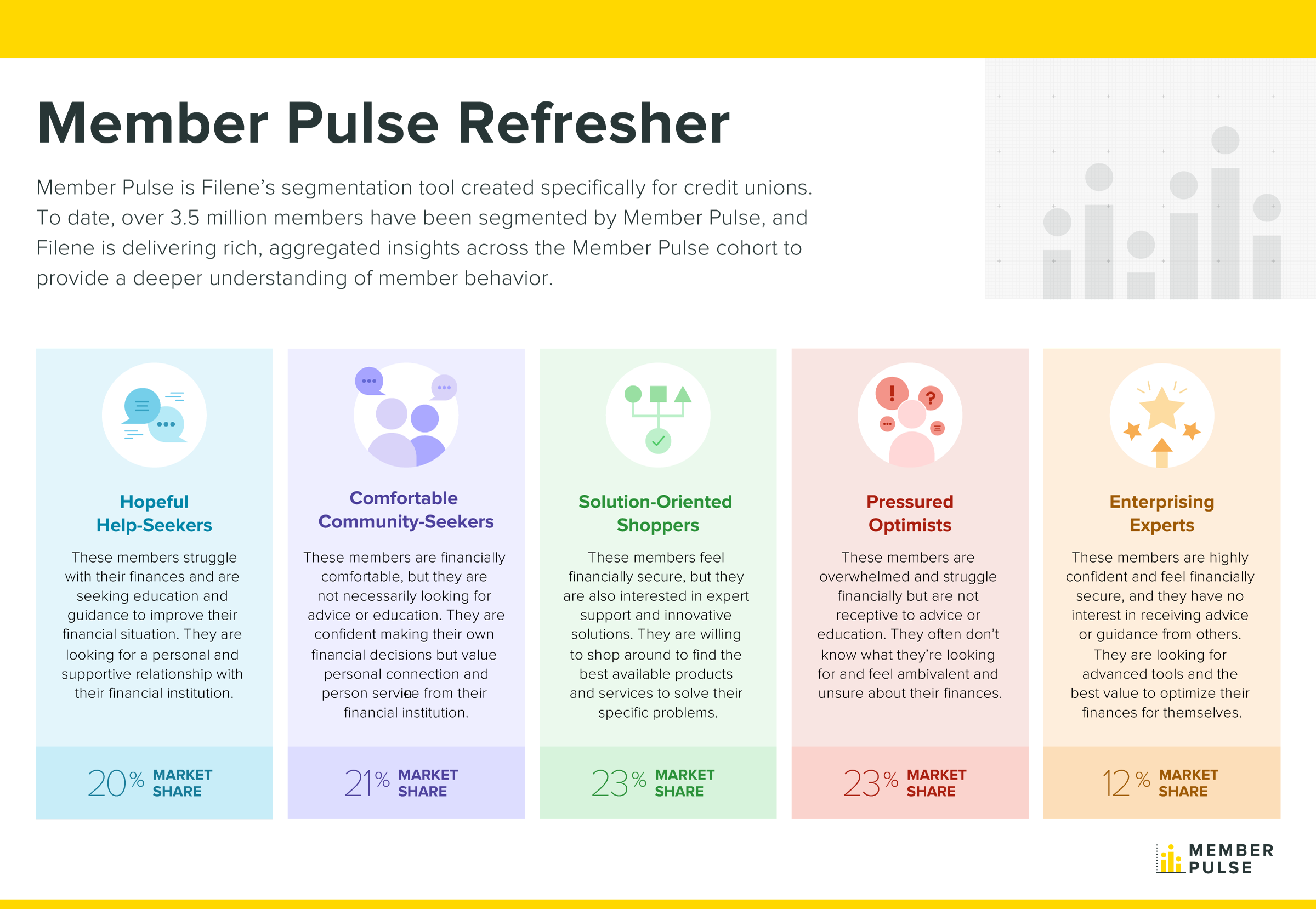
Thanks to our cohort of 20 credit unions in Member Pulse, we’ve been able to analyze the checking account behavior of over 3.5 million members. We’ve identified key trends in how members spend their money; credit unions can use these findings to develop the right checking/transaction accounts with the right features for their members.
Let’s start with the Hopeful Help-Seekers. These members actively seek help and support from their credit union. They know their finances aren’t the best, and they are “hopeful” that credit unions can give them friendly, accessible advice and expertise. These members are often credit unions’ most prolific debit card users, spending more than any other segment in most categories from general merchandise to restaurants to grocery.
- Why this matters: Hopeful-Help Seekers are some of your biggest supporters, and they are looking for financial help. They dominate credit unions’ transaction records because they are actively using their credit union debit cards for the majority of their transactions—they have credit unions already locked in as their preferred banking partner. Thank them for their support, and start rewarding their loyalty by offering help and advice to grow their finances. They’ve already chosen you—help them see it was the right choice. As a group that is struggling a bit more than others financially, the offer of free checking accounts, paired with advice on growing balances, is likely to hold immense appeal. Lead with the debit card.
Comfortable Community-Seekers, by comparison, have higher average balances than any other segment, though they have fewer day-to-day transactions. Their primary spending category on their checking account is “banking and credit cards”: making payments on their credit card, which is their primary spending vehicle. These are loyal members who are not looking for help, but who love the personal service their credit union provides and the value their credit union brings to their community.
Solution-Oriented Shoppers are in a similar situation: high average balances, fewer purchases and more payments to other financial institutions, including P2P. These members are rational decision-makers, choosing the product that best fits their needs, not just on rate or pricing but functionality, ease of use, features, benefits, rewards, fees and other factors.
- Why this matters: Both Comfortable-Community Seekers and Solution-Oriented Shoppers use their checking account to hold their day-to-day balances, but they spend mostly via credit cards and bill pay. To build checking relationships with these segments, consider interest-bearing products to encourage balances.
Members who are Hopeful Help-Seekers dominate nearly every spending category, while Pressured Optimists and Enterprising Experts value easy control over their P2P payments.
Meanwhile, Pressured Optimists and Enterprising Experts at first appear as two very different groups. Pressured Optimists, despite struggling with their finances, are hesitant to find support and instead are optimistic that things will turn around on their own. Enterprising Experts, on the other hand, are the true DIY-ers of our segmentation. They don’t ask for help because they are confident they will find the best answer for themselves.
But what do these two groups have in common? Both send a fair amount of money over P2P networks.
- Why this matters: Filene Centers of Excellence Research has showed that frictionless payments are a big deal right now. Credit unions who want to stay competitive must meet consumers’ demands to send and receive money instantly, 24/7 with no delays. What Member Pulse shows is that this feature is even more important to some members compared to others. Nationally, Pressured Optimists and Enterprising Experts make up 35% of market share—is your credit union meeting their needs?
- For Pressured Optimists, the best opportunity here is to make account opening and operating as easy as possible. Think “simple”. With this group’s propensity towards P2P payments, make sure that is advertised as a key feature of the account.
- For Enterprising Experts, easy is important as well, but the scope of features matters even more: digital assets wallet, easy transfers to wealth management services, being the hub of their portfolio. Let them drive the conversation; checking accounts can be a first step towards meeting their niche needs down the line.
There is no single “right” transaction account for every member. The right mix of features depends on who your members are, how they use their accounts, and what they expect from their credit union.
Understanding your credit union’s unique mix of Member Pulse segments can help you turn those differences into better product decisions and more relevant member experiences.
Curious what your member mix could reveal? Email [email protected] to learn more about Member Pulse.
— CV