
As Filene prepares to launch the Center of Excellence for Differentiation & Storytelling, we’ve spent several months in conversation with leading experts whose work sits at the intersection of consumer behavior, relationship-building, organizational identity, growth, and storytelling. Five experts were asked to reflect on challenges Filene has identified as critical for credit unions, including stagnant growth, generational shifts, and questions of organizational relevance, belonging, and visibility. During our fellow selection process, these candidates shared their thought leadership from past and planned research on how to move credit unions forward in tackling these industry imperatives.
As the Center formally gets underway this month, the questions below and the insights gained from these five experts can accelerate your credit union’s differentiation and storytelling strategy.
Does your credit union create a distinction between differentiation and storytelling?
What our panel of experts made clear is that storytelling is not a substitute for a differentiation strategy. It is a mechanism for distributing it. Differentiation establishes what is worth spreading. Storytelling determines how it spreads.
These two strategies often get conflated into one, with storytelling attempting to do the heavy lifting of creating differentiation. What our panel of experts made clear, however, is that storytelling is not a substitute for a differentiation strategy. It is a mechanism for distributing it. Differentiation establishes what is worth spreading. Storytelling determines how it spreads. When organizations attempt to use storytelling to resolve unresolved differentiation through better campaigns, more content, or broader reach, the result is increased activity without increased traction. Effective storytelling starts upstream with clear differentiation.
Differentiation requires making explicit, strategic choices about who your organization is for, what you believe, and how you are willing to be different. It then requires taking that strategy and applying it meaningfully to the products and services that you build and support for your prospective members to create a clear and coherent picture that consumers can see and feel.
When differentiation is underdeveloped, organizations struggle not because they lack purpose, but because they have not translated that purpose into a small number of clear, testable strategic commitments. Until those commitments are made about belief, audience, and trade-offs, performance issues signal unresolved strategy, not execution failure.
Who is your credit union truly for, not just able to serve?
The challenge for credit unions is pushing beyond the structural segmentation and defining not only who they can serve, but who they are best positioned to serve.
This is a mindset shift for many credit unions, but one that research consistently shows is very important: you need to make choices about who you are focusing on and who you are not in order to serve anyone well. Historically, this choice was made for credit unions as there was no difference between who a credit union was truly for and who it was able to serve. Single SEGs created a perfect overlap, and that mindset has largely stayed even as fields of membership grew larger and more geographically and socioeconomically diverse. Commitment to financial inclusion also makes it difficult to explicitly prioritize one segment of the population over others as the very nature of focusing on one segment of the population can feel exclusionary. At the same time, the cooperative model is already structurally built for segmentation, whether it be by community, affiliation, or shared identity. The challenge for credit unions is pushing beyond the structural segmentation and defining not only who they can serve, but who they are best positioned to serve.
Has your credit union defined what makes it distinct?
Two of our experts raised helpful frameworks for thinking about defining differentiation. The first, brand belief, goes beyond a mission statement or a list of values. A brand belief is a worldview, which for credit unions would be made up of a conviction about money, people, and the role financial institutions should play in communities. Importantly, it’s built on the foundation of something that competitors cannot credibly claim. For most credit unions, these are embedded in their founding documents but are treated as implicit earmarks of the industry rather than sharpened into a clear strategic position. In many cases, these have also evolved over time without being explicitly named as credit unions have expanded and strategies have shifted.
Brand beliefs are further reinforced and clarified through the second helpful framework, the positioning of points of parity and points of difference. Points of parity are the table-stakes elements of a financial institution and establish a sense of credibility. Points of difference, by contrast, are the elements that make you desirable and meaningfully distinct so members know why they are choosing you over another financial institution. When credit unions rely primarily on shared language like community‑focused or member‑owned, they reinforce points of parity without driving the distinction of why they should be chosen over another financial institution.
The research on differentiation is clear: to be differentiated requires trade-offs. Strategic differentiation means choosing which attributes to emphasize and which to de-emphasize, even when those choices feel uncomfortable. Relying on points of parity within the industry or refusing to make exclusions results in confusion when clarity is needed by consumers. Despite the discomfort, it is essential for credit unions to take this step so they can build a clear foundation for their brand beliefs and build a relationship with their audience.
Is your story ready to be told?
Research consistently shows that well-constructed stories can increase memorability, emotional connection, trust, and relevance. When storytelling does work, the research shows it is because three conditions are already in place.
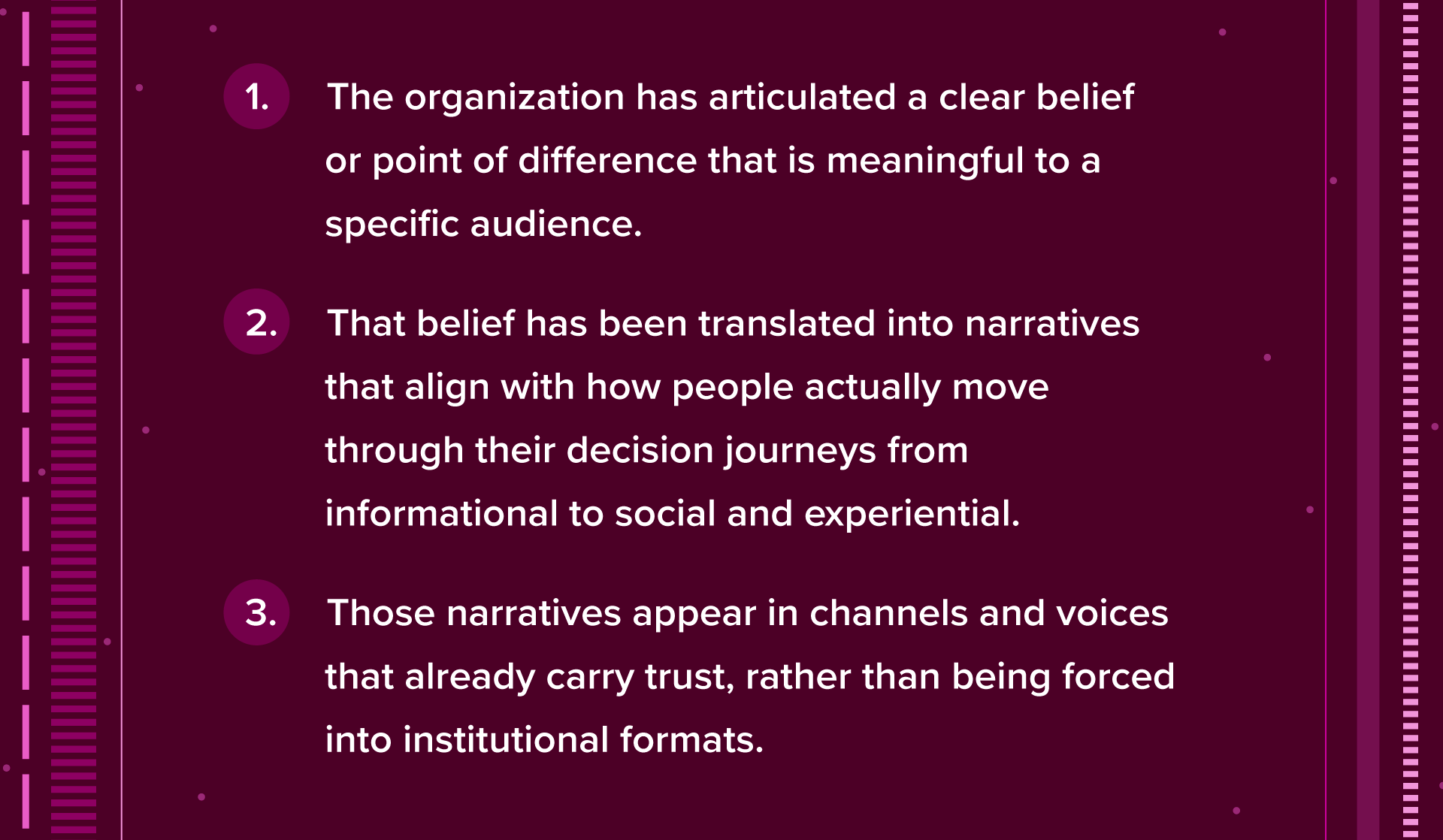
Under those conditions, storytelling functions as intended: not as a creative exercise, but as a multiplier. It reinforces clarity, accelerates learning, and helps the right audiences recognize themselves in what an organization stands for. Without that foundation, even excellent storytelling execution struggles to convert attention into action, not because the stories are poorly told, but because they are carrying ideas that are not yet distinct enough to matter.
Is your storytelling more focused on what is said than what is heard?
In practice, storytelling is tactical, shaping how meaning travels by influencing where it appears, who carries it, and how it’s interpreted across spaces. Stories are not fixed messages; instead, they move through networks, are reshaped by their audiences, and gain or lose credibility depending on who tells them and where they appear. As one researcher put it, the managerial task is not to “broadcast” stories. Credit unions need to equally think about how they get the story out and where and how it lands. Stories need to reach the right people, and they need to land in a way that drives behavior. This requires stories that aren’t about the credit union; it requires stories that are about the consumer and what the credit union can do to shift their experience.
Where, and for whom, is your current storytelling breaking down?
When credit unions talk about needing better storytelling, it’s often a reaction to an already visible pattern of stalling growth and using messaging as a quick-fix lever. The insights shared from our panel of researchers pointed to the need for a deeper look into the issue to understand where the breakdown is occurring and who they are targeting but missing.
Starting with the who, define which stage of the acquisition journey you are focused on: acquisition of new members, retention and expansion of current members, or reactivation of dormant or past members. If you are focused on new members, the breakdown can happen at four critical, and sometimes overlapping, junctures: awareness, attractiveness, affordability, and availability. For existing members, the second stalling point occurs where members have a shallow relationship, reflected in limited product usage, declining satisfaction, or weak word-of-mouth brand sharing.
The practical implication is straightforward: before investing in a new story, you need to map the breakdown point(s) you’re trying to solve and make deliberate choices about which audience to prioritize. Once that diagnostic work is done, storytelling becomes much more useful, allowing you to evaluate which stories resonate with which target audiences, instead of relying on storytelling to fix an issue messaging alone is insufficient for.
Are you leveraging existing communities to spread your message?
Several experts spoke to the power of tapping into existing networks that already show a propensity for credit unions. These are not communities that are defined by traditional geographic or demographic factors, but by aspects of their identities (e.g., beliefs, hobbies, interests) and this shared identity creates trust and intimacy between members of the group. These groups can act as catalysts for your message and bring authenticity to your brand through their organically occurring brand ambassadorship. Leveraging these networks allows you to amplify storytelling through existing channels. This is a twofold opportunity, allowing credit unions to deepen relationships with current members and increase the spread of their message with fewer resources through members who already champion their brand. This takes strategy from answering where and to whom are we telling our story a step further by adding who is already telling our story and how do we extend their reach.
Where the Center is going
The conversations reinforced that some insights are already well supported by existing research. We know that narrative structure interacts with the strength and clarity of organizational differentiators. We know that language choice and framing influence perception and decision‑making. We know that communication is more effective when it matches where someone is in their journey, and it’s especially effective if it’s being told in an organic environment by someone they already trust.
Where the Center of Excellence for Differentiation & Storytelling will focus is on advancing industry‑specific learning: clarifying credit union identity in a changing competitive landscape, linking differentiation to trust and long‑term member relationships, and translating authentic differentiation into strategies that can be tested, refined, and scaled across diverse institutions.


